
How to File an EU Trademark with Claude
In 2015, a hidden trademark killed our startup's name before we'd even launched it.
My co-founders and I were brainstorming a name for our baby - a recruitment marketing platform.
Since our product helped users to find local jobs, we arrived at a possible startup name: Scoutling (scout - self-explanatory base + -ling suffix to signify a mascot).
We ran it by our legal counsel, they searched the US Patent and Trademark Office (US PTO) database and found an issue.
A startup in the recruitment space - named Findly - had filed a trademark application a few months prior.
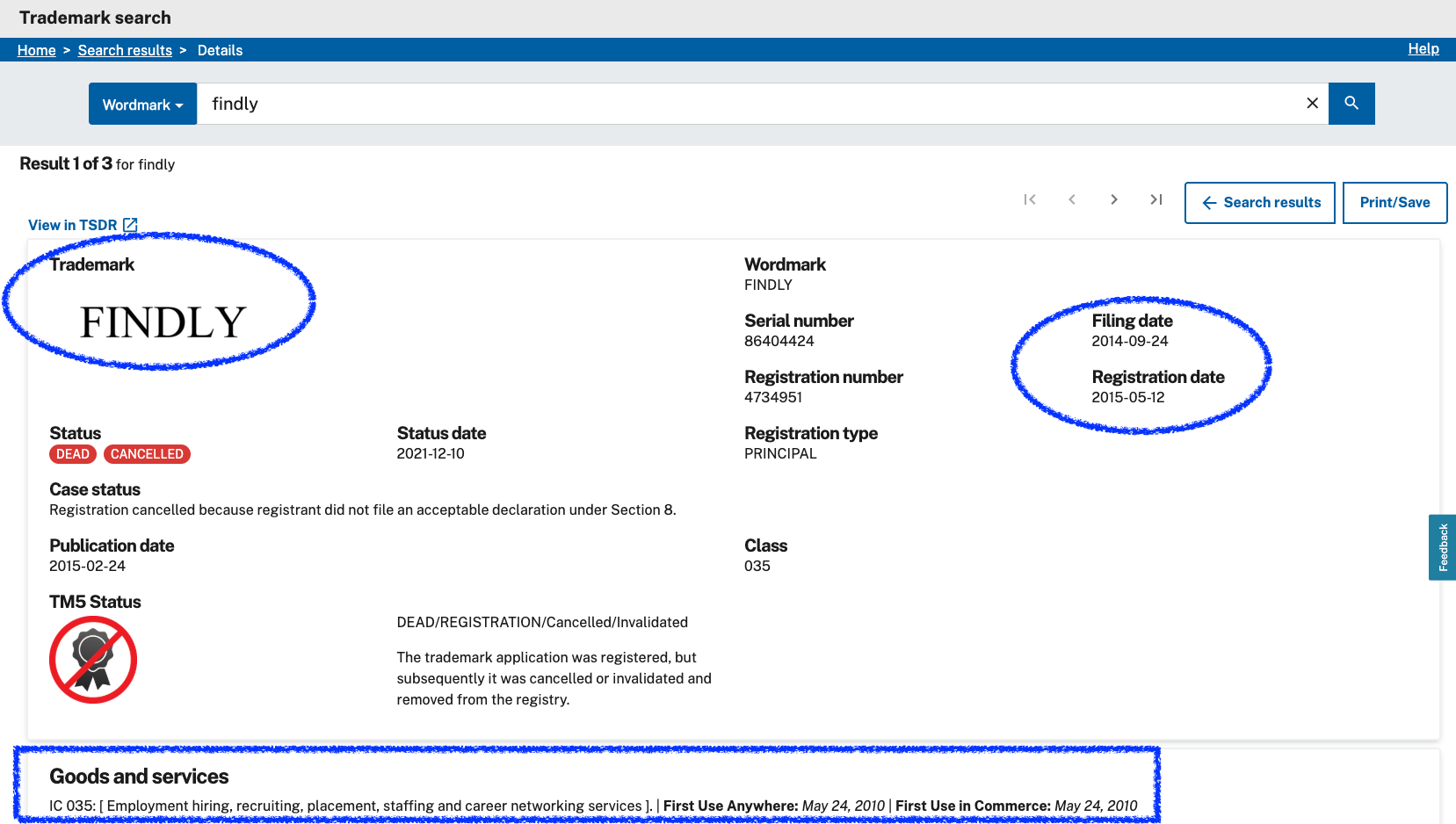
Our legal counsel explained that due to this particular trademark registration, any company name that might be confusingly similar to Findly would be a no go. Permutations/synonyms of the verb "to find" - something like "to scout" - was therefore off the table.
The registered trademark has done exactly what it was supposed to.
I didn't forget and promised myself that future endeavors would stand on a solid legal foundation. But the problem was that this used to be relatively expensive and tedious. At least if you were a startup.
Ten years later, that's no longer the case. I just filed my own trademark in 90 minutes for €350.
In the past, the same thing would have cost me thousands of euros and taken days/weeks of collaboration with legal professionals.
This post tells the full story from idea to trademark application. It covers why you might want a trademark in the first place, how the whole thing actually works, and what I learned about doing legal work with an LLM partner. It's not a one-size-fits-all solution, but it works for specific use cases (like the one I had).
By the end of this post, you should be able to file your own EU trademark in an afternoon (bonus: downloadable Claude skill attached further below).
What's a Trademark Even Good For?
Let's do a quick 80/20 on what intellectual property (IP) law actually is. It lets you own and defend intangible assets like:
- Trademark → protects brand identifiers (names, logos, slogans). Stops competitors from launching "YOUR COMPANY NAME" next year and confusing your customers. Requires registration. Renewable forever in 10-year cycles.
- Copyright → protects creative works (text, images, music, code). Automatic from the moment of creation. No registration needed. My blog posts are copyrighted the moment I hit publish.
- Registered Design → protects the appearance of a product (shape, packaging, GUI). Requires registration. Up to 25 years.
- Patent → protects technical inventions. Requires registration, expensive, max 20 years. If you invent cold fusion, you might want to think about patent filing.
- Trade Secret → protects confidential business info (formulations, supplier lists, pricing strategy). Lasts as long as the secret stays secret. Relies on contracts, practical security, and handshake agreements.
They overlap but each layer covers a different asset. A trademark is the cheapest piece of insurance you can buy for a brand you actually believe in.
So What Does a Trademark Actually Give You?
A registered trademark gives you a right to exclude. Specifically for EU trademarks this means:
- A legal monopoly on your name in your field across 27 EU member states, for 10 years, renewable forever.
- A defensive shield against squatters. Someone else could register your brand name in your class next year and then demand you stop using it. This happens all the time.
- Leverage with Amazon, Shopify, Google, Meta, and every other platform that requires proof of trademark ownership before they'll enforce takedowns.
- An actual asset on your balance sheet. Transferable, licensable, and worth real money when you raise capital or get acquired.
- The right to use the ® symbol. I think that's kind of cool.
What it does not give you: a monopoly on the dictionary words in your name. The mark protects the name as a brand identifier, not the words themselves.
Why I Wanted to File
Now, let's come back to the present day.
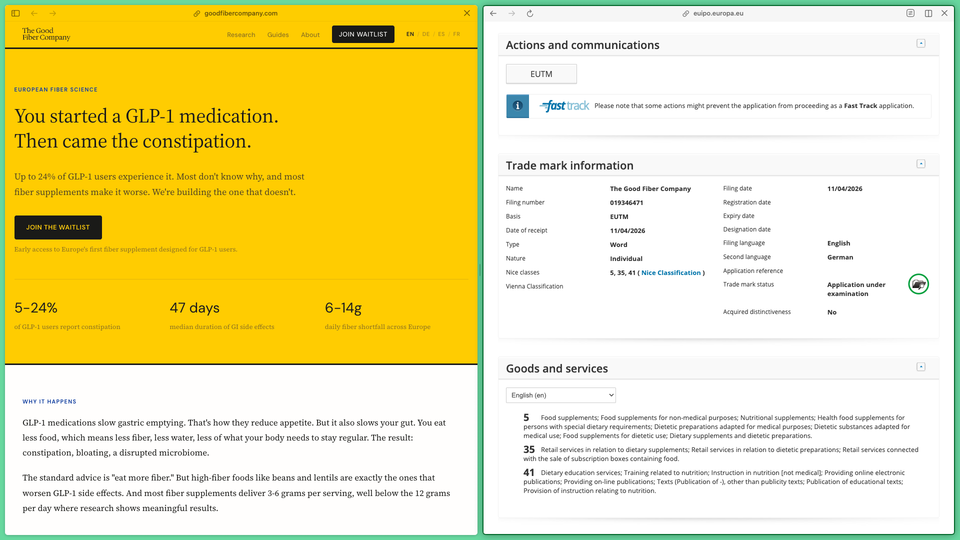
I'm currently building The Good Fiber Company - a research publication and eventual supplement brand targeting European consumers on GLP-1 medications like Ozempic.
My working hypothesis is that the dietary fiber product is a commodity.
Psyllium husk is psyllium husk. Chicory inulin is chicory inulin. Whether you buy it from me, from Amazon, or from a pharmacy down the road, it's still the same molecule.
Brand and distribution are the moats.
Editorial authority. Trust. Content reach across different languages. And eventually, a direct-to-consumer channel people actually want to buy from. That's what I'm building.
And if the brand is the moat, then protecting the brand name is not optional.
What a Trademark Lawyer Actually Does
To understand why self-filing is even possible, it helps to know what trademark lawyers do in the first place. Here's the typical workflow for a straightforward EUTM filing:
- Clearance Search → Run professional databases to check for conflicting marks. Produce a risk report.
- Classification Advice → Pick the right Nice classes (as in "Nice, France"). Draft the goods/services description.
- Mark Selection → Advise on word mark vs figurative mark, distinctiveness, strong vs weak elements.
- Filing the Application → Fill in the EUIPO form, pay the fee, manage correspondence.
- Examination Response → If EUIPO raises an objection on absolute grounds, draft the response.
- Opposition Handling → If a third party opposes, represent you in proceedings.
- Portfolio Management → Track renewals, monitor the register for conflicts.
Typical costs in Europe (attorney fees only, on top of EUIPO's official fees):
- Simple filing: €500-2,000
- Clearance search with opinion: €400-2,500
- Response to an absolute grounds objection: €500-1,500
- Opposition proceedings: €1,500-7,000
Total for a typical straightforward EUTM through an attorney: €1,500-3,000 all-in.
Steps 1, 2, 3, and 4 are exactly what an LLM with good domain knowledge can help you do, if you bring the judgment. Steps 5, 6, and 7 are where you'd actually need a human professional, and only if something goes wrong. For a clean first filing in an uncrowded space, the bottleneck isn't legal expertise. It's knowing which questions to ask.
The Walkthrough
I did everything using Claude Opus 4.6 but I'm sure you could use any other frontier model to get the job done. Even if you decide to use your own intelligence, these steps should transfer easily.
Scoping, Planning, and an Unexpected Surprise
As mentioned earlier, the entire trademark "project" came about due to my hypothesis that brand equity matters.
A few weeks ago, I prompted Claude to scope a variety of legal tasks:
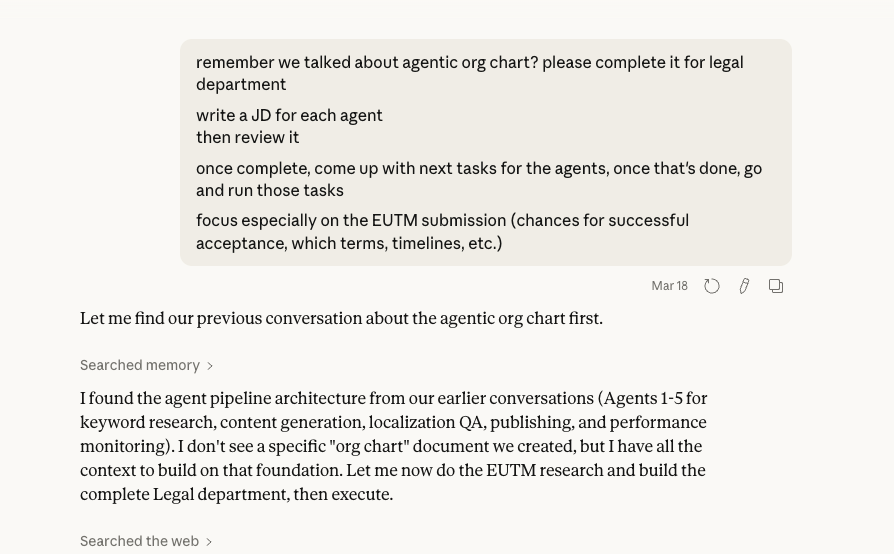
Eventually, this helped me to get a basic understanding of:
- What: Trademark application
- When: Whenever I was ready
- How: Fast Track application via EU IPO website
I let Claude summarize the findings in a markdown file and shelved it for later. Then, on March 23rd, I re-opened this thread and kicked it off with the following prompt:
let's tackle the EUTM registration. approach it like a senior partner at an eu ip/tm law firm and give me the full download. what to do, what protections, what's not protected, any other recommendations.
The biggest surprise/insight from this step was that Claude found a way to reimburse up to 700,- of the costs.
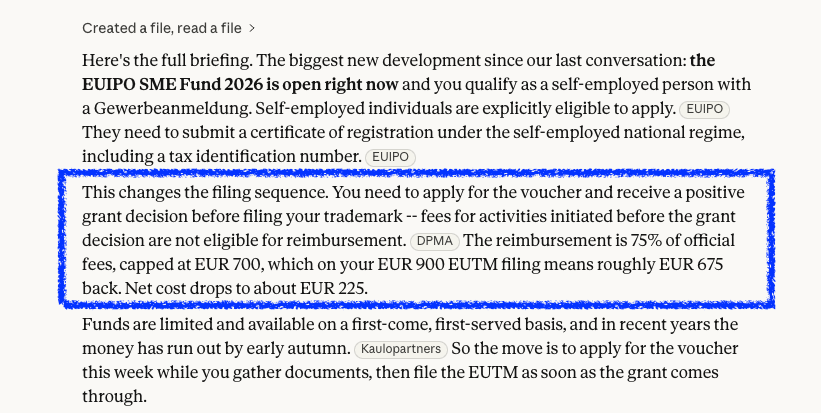
75% of whatever I paid to EUIPO, capped at €700. If I didn't activate the voucher within 30 days by submitting a reimbursement request, it would expire and I'd forfeit the grant.
This changed my sequence. Now, I had to apply for the SME Fund voucher first before doing the trademark filing. Everything is done via the same EU IPO account that you need to create.
Everything went quite smoothly. I applied for the voucher on March 23rd and received an approval on April 10th. Reimbursement application followed on April 11th (more on that later).

After receiving the voucher approval, I had a choice:
- Hire a trademark lawyer. Pay €1,500 to €3,000 for a clean filing. Wait days/weeks for them to do the work. Burn most of the voucher on their fees (which, by the way, aren't even reimbursable under the grant).
- Do it myself (with Claude).
Match the Cost of Help to the Stakes and Complexity
If my mark had been contested, or if the space had been crowded, or if the filing had touched classes with regulatory complexity (medical devices, pharmaceuticals, financial services), I would have hired counsel without thinking twice.
But my filing was simple: clean mark and uncrowded space. A €350 self-filing with Claude guidance sounded rational to me. Easy choice. I went with number 2.
I gave myself an afternoon.
Phase 1: Strategy (~30 minutes)
I uploaded the grant decision PDF to Claude along with my project files and asked for a filing strategy. The framing I used: "do a thorough plan, review it as if you were a European IP law firm partner, and give me guidance."
The output was a full memo: which type of mark to file (word mark, not figurative), which classes to pick, which route to use (EUTM at EUIPO, not national, not Madrid), and what to skip (designs, UK, international filing, all deferred).
The two decisions that mattered most:
#1.1: Word mark over figurative mark
A word mark protects the name in any typeface, color, or styling. It's broader, stronger, and future-proof. A figurative mark is keyed to a specific visual presentation and gets outdated the moment you refresh your logo.
#1.2: Three Nice classes
- Class 5 → food supplements (the product I'll eventually sell)
- Class 35 → retail services (the online store I'll eventually run)
- Class 41 → online publications and educational services (the blog that exists today)
Claude initially suggested only Classes 5 and 35.
I pushed back: "what's the risk of not registering Class 41?" and the recommendation changed. Leaving it out would mean the one asset actually in market today would be the one with the least protection.
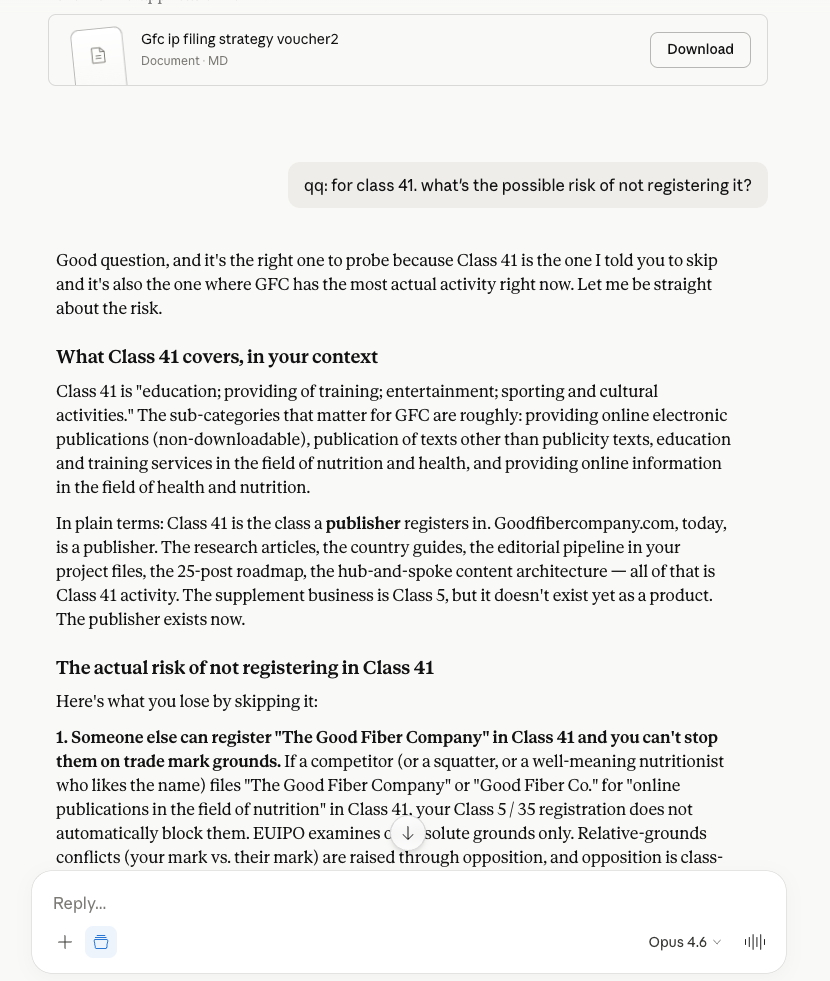
That exchange (me pushing back, Claude updating) is an important thing I want you to take away from this post. Claude - like all other LLMs - fail. It's a collaborator that gets certain things wrong and improves when challenged. The value isn't in Claude having all the answers. It's in being a sparring partner to accelerate/improve your own work (if used well).
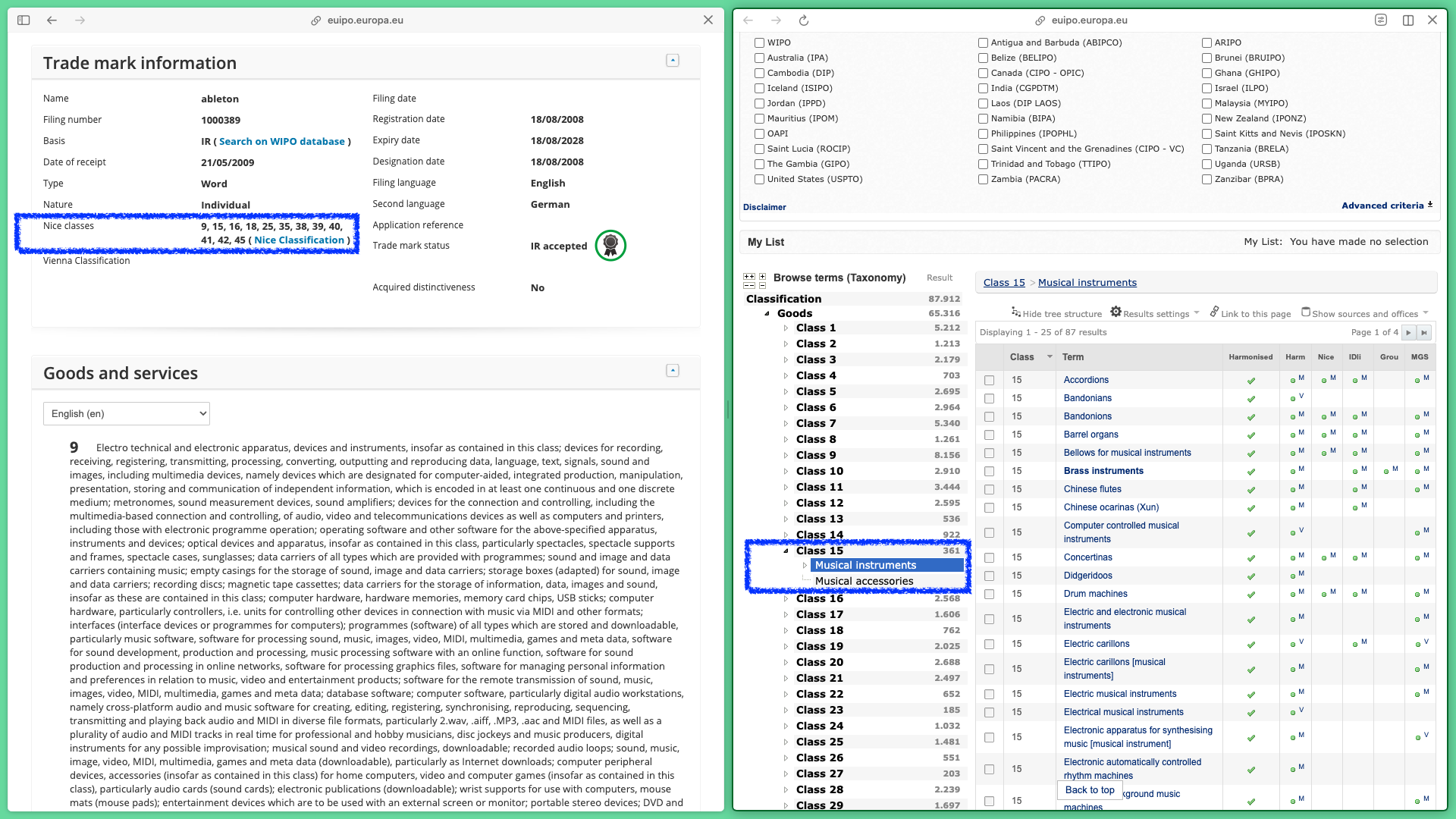
I'd highly encourage everyone to do this work/research at least once and dive into the EU IPO eSearch database and compare it with the standardized trademark class database.
Open two tabs side-by-side and search for any brand that you know well and see what they tried/managed to register.
Phase 2: Clearance Search (~15 minutes)
Before paying anything, I needed to check if "The Good Fiber Company" was even available. This is the step founders skip and later regret.
Granted, I had done a superficial search earlier in March to confirm that the trademark project would be worthwhile. But at this stage, I re-did a more thorough screening to be on the safe side.
Claude walked me through TMview (the free EU-wide trademark database) with specific search queries: "good fiber," "good fibre," "fibre company," "good fiber," and the same searches filtered to Classes 5, 35, and 41.
The results were almost entirely irrelevant. Textile fiber marks. Construction fiber marks. Optical fiber marks. The dietary-fiber space in trademarks turned out to be uncrowded. Lucky me.
One yellow flag: a live EU word mark for "good fiber" (two words, with a leaf logo) in Classes 22 and 24. Textile fiber, completely different industry. Claude's assessment: conceptually unrelated, class separation strong, opposition risk low.
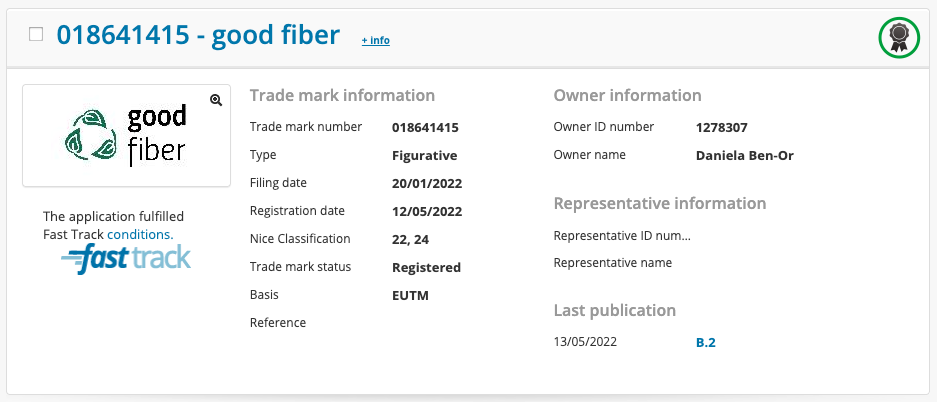
Decision: Clean enough. Move on.
Phase 3: Filing (~30 minutes)
This is where it got a bit more hands-on.
The EUIPO Easy Filing form is a multi-step flow, and I had Claude guiding me screen by screen. I sent screenshots. Claude told me exactly which fields to fill, which options to click, which terms to pick from the Harmonized Database (HDB) picker.
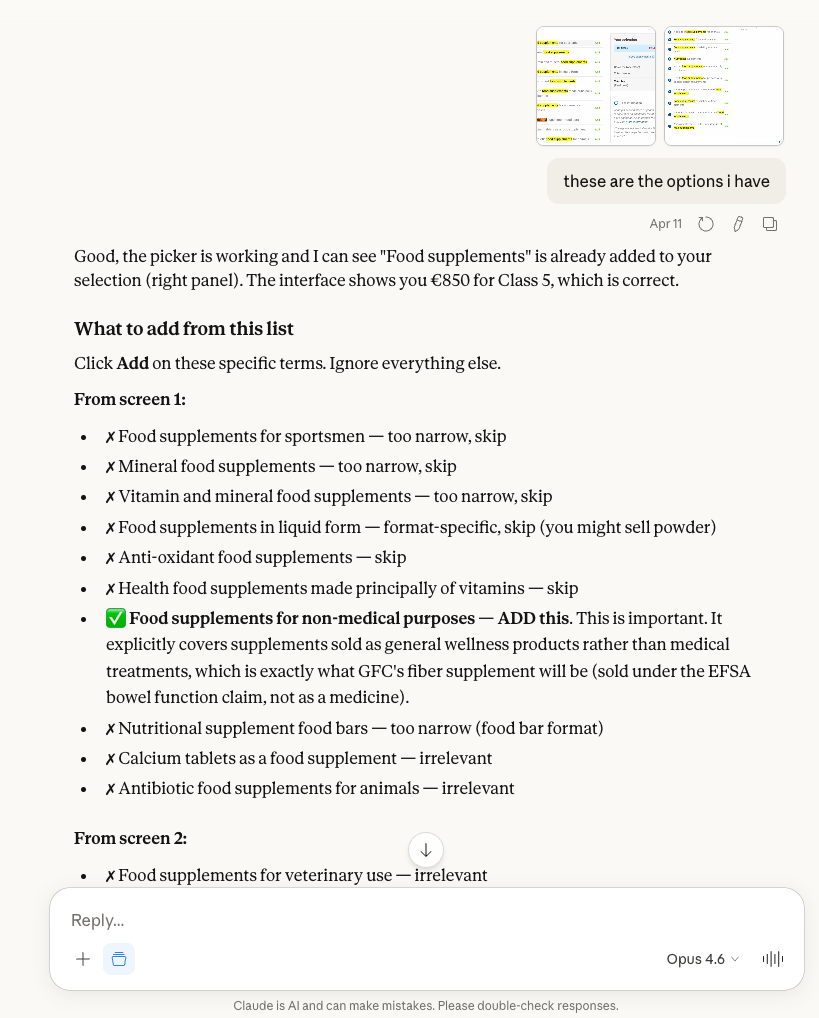
The HDB matters because it's what keeps you eligible for Fast Track. EUIPO's accelerated examination route. If you pick goods/services from the pre-approved database, Fast Track is automatic and your mark gets published in ~2-4 weeks instead of ~8 weeks. If you type freeform descriptions, you lose it. That's a big one.
I added 19 terms across the three classes, all from the HDB picker. Final fee: €1,050.
- €850 basic fee (one class)
- €50 for the second class
- €150 for the third class
Fast Track confirmed. Everything looked right.
I clicked Go To Payment. Entered my card. Clicked Pay.
The payment authorized. Authorization code received. €1,050 debited from my account.
Then I clicked Continue.
Phase 4: HTTP 405 Error
It wouldn't be a good story if there wouldn't be a complication 🙄
So, of course the site decided to throw a 405 error right before completion.
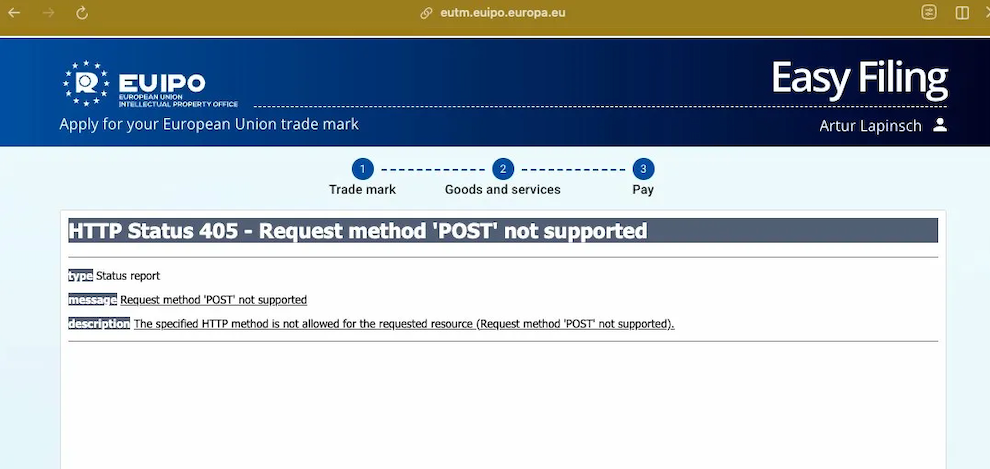
My application was officially in limbo. I refreshed nothing. I clicked nothing. I sat very still.
Claude helped me think through it:
- Don't refresh the error tab. A POST resubmit could trigger a duplicate charge.
- Don't file a second application. Same reason. I wouldn't have done that anyway.
- Check the EUIPO Portfolio. The application might still show up as the backend catches up.
- Check Communications, email, and eSearch Plus. Any of those confirming the filing would mean the HTTP 405 was cosmetic.
- If nothing appears in 2-4 hours, contact EUIPO Monday morning with every detail of the failed transaction.
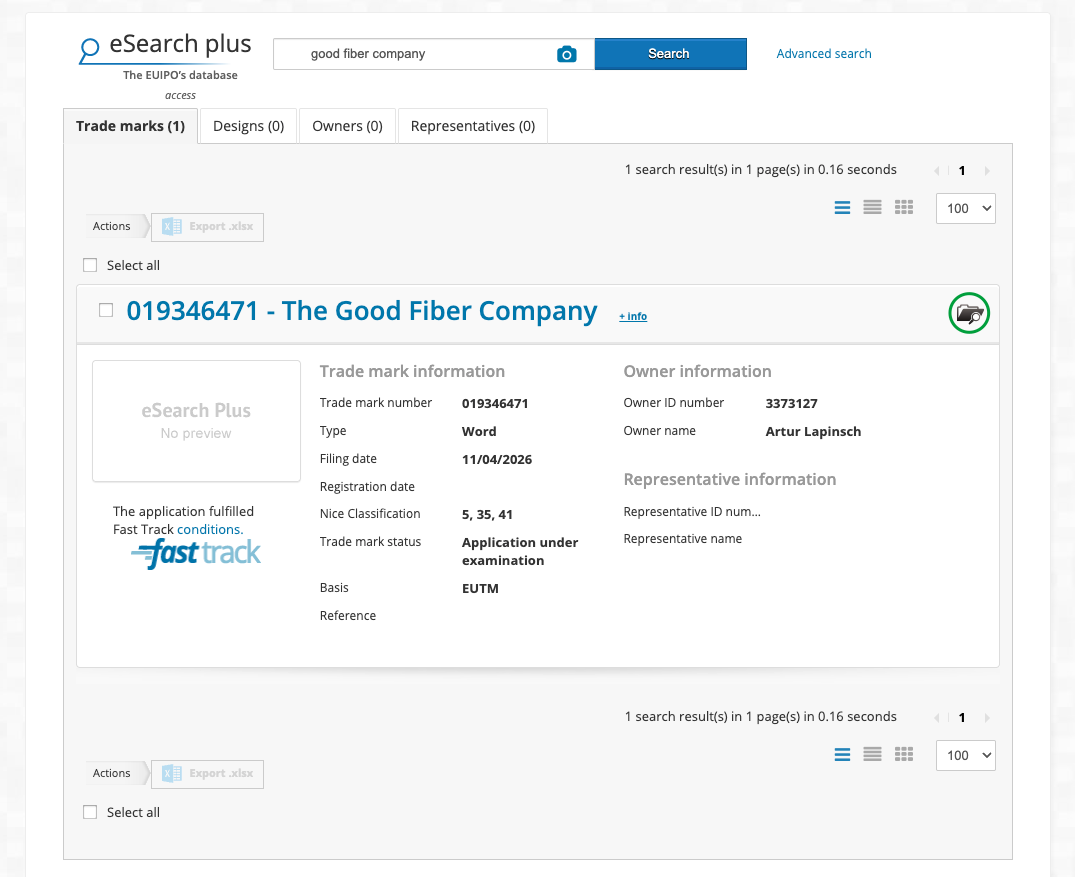
I checked Portfolio, my emails, and eSearch plus two times within 30 minutes. Nothing.
I had earned myself the pleasure to call the EU IPO customer service number on Monday morning. It was time to go outside for some fresh air.
When I got home, I checked my portfolio once more for shits and giggles and there it was:
EUTM 019346471. The Good Fiber Company. Word mark. Filed 11/04/2026. Classes 5, 35, 41. Owner: Artur Lapinsch.
The filing had gone through. I felt relieved.
The HTTP 405 was a cosmetic failure of the "Continue" button. The underlying transaction (application + payment + signature + goods and services) had actually been recorded by EUIPO's backend. The confirmation page just never rendered. Two days later, I also haven't received an email yet.
Lesson learned: Governmental sites can be quite buggy (and that's scary). So if you are reading this and you work for EU IPO, please look into it.
Nonetheless, it was done. Finally. Time to move on.
Phase 5: Activating the Voucher (~10 minutes)
Once the application was confirmed filed, I submitted the SME Fund reimbursement request from the same EUIPO portal (different subsystem, same login). Entered the application number, the filing date, the €850 basic fee, the €200 class fees.
No document uploads needed. Because SME Fund is run by EUIPO, they already have the filing and payment records in their own database. Convenient.
Clicked Apply.
Your request has been submitted.
Voucher activated. €700 reimbursement expected within 30 days.
Done and done.
A Few More Details
The Numbers
- Time from zero to activated voucher: ~90 minutes (not counting the 90 minutes of waiting for the HTTP 405 to resolve itself)
- Total paid to EUIPO: €1,050
- SME Fund reimbursement: €700 (expected within 30 days)
- Net out-of-pocket: €350
- What I'll (potentially) get: 10 years of trademark protection in three Nice classes across 27 EU member states, for the single most important asset I'm building.
- Comparable cost with an attorney: €1,500-3,000 all-in
In my book, that's the bargain.
Other Questions
Another founder buddy of mine asked a few questions:
Q1: What Info Do You Need for a Trademark Application?
Surprisingly little.
- The mark itself → the exact text ("The Good Fiber Company"). Spelling, capitalization, spacing, all locked at filing.
- Your personal or company details → name, address, VAT/TIN if you have one. For a natural person, your home address is fine.
- Nice classes → pick them deliberately. Each class costs money (€50 for the second, €150 for each additional). Only claim classes that reflect real or imminent business activity. Trademarks have a use it or lose it rule. If you don't genuinely use the mark in a claimed class within 5 years of registration, that class becomes vulnerable to revocation.
- Goods and services descriptions → pick them from EUIPO's Harmonized Database (HDB). Don't type freeform text or you'll lose Fast Track.
- A card to pay → €850 to €1,050+ depending on classes.
Additionally, you'll need Patience (~4 months for a clean registration).
After the initial filing, you get a first examination report within a few weeks, confirming whether your classification and formalities are in order. If everything is clean (which is the whole point of using Fast Track and the HDB), the application moves to publication in the EU Trademarks Bulletin roughly 2 to 3 weeks after filing. Then comes the 3-month opposition window, during which holders of earlier rights can challenge your mark. If no one opposes, and no absolute grounds issues are raised by the examiner, the mark is registered shortly after the opposition period closes.
Start to finish, a smooth Fast Track filing lands at registration in about 4 to 4.5 months.
Q2: What's the Process to Get the SME Fund Voucher?
Simpler than I expected.
- Check your eligibility → The EUIPO SME Fund is open to SMEs (including natural persons operating a business) established in any EU member state. Check the current call for proposals on euipo.europa.eu/sme-fund.
- Submit the application → Takes about 30 minutes online. You'll need your business details, an idea of which voucher types you want (Voucher 1 for IP Scan, Voucher 2 for Trademarks and Designs, Voucher 3 for Patents, Voucher 4 for Plant Varieties), and a bank account for reimbursement. I did Voucher 2.
- Wait for the grant decision → Takes a few weeks. Comes as an email to your email.
- Activate the voucher → Within deadline by submitting a reimbursement request (after filing for the TM). For Voucher 2, the activation window is one month from grant notification.
- Wait for reimbursement. 30 calendar days from submission.
The program is underused. Seriously, apply. Worst case you spend 30 minutes and get rejected. Best case you file a trademark for €350 net.
Q3: Do I Need to Incorporate First?
Nope. I filed as a natural person (Artur Lapinsch, Berlin). Eventually, I'll assign the mark to the company using a free EUIPO recordal form. Standard practice for founders.
Q4: What If Someone Files Against Me?
Within 3 months of publication, any third party can file an opposition. If that happens, you either negotiate a coexistence agreement, hire a lawyer, or fight it. Opposition rates are around 1 in 10 EUTM applications.
This is exactly the scenario where the cost calculation flips. A contested opposition can run €1,500-7,000, and at that point, you absolutely want professional counsel. Don't self-represent in opposition proceedings.
But, we'll cross this bridge if we get there.
Closing Thoughts: It's Not About Claude
The real story here isn't about LLMs.
It's that tasks like this used to be opaque, and opacity forced founders to hand them over in the first place. A trademark filing looked like a black box, so you paid someone who knew what was inside the box. That trade is different now. Not gone, but different.
As an entrepreneur, you're constantly being told to delegate, outsource, and stay in your zone of genius. Most of that advice is good. But some of it is cover for tasks you've never actually examined. You don't delegate them because they're genuinely beyond you. You delegate them because you've never stopped to ask what they really involve.
Getting some sovereignty back means doing the examination once. Not every time, not for every task, but once, for the things that matter to your business. Sometimes the answer is "yeah, this is genuinely complex, hire the professional." Sometimes the answer is "wait, this is 90 minutes of form-filling dressed up as expertise." You can't tell which is which until you look.
So the takeaway isn't "use Claude for legal work." It isn't even "file your own trademark." It's three things:
Question the task. Understand what's actually involved. Then do it your own way.
Whether that means an LLM, a lawyer, a weekend of your own research, or some combination of the three, the point is that you're the one deciding.
What Now?
I packaged everything I learned during this process into a Claude skill that you can install in your own Claude project. It covers:
- Strategy thinking (word mark vs figurative, class selection, EUTM vs national vs WIPO/Madrid)
- Clearance search methodology (TMview queries, what to look for, what to ignore)
- The Easy Filing walkthrough (screen by screen, HDB picker tactics, Fast Track preservation)
- SME Fund reimbursement flow
- Troubleshooting
Get the Claud skill for free here 👇
 artlapinsch
If you end up filing your own trademark after reading this, let me know how it goes.
Until next time ✌️
Art
Massive thanks to Skander, Andreas, MKO, and Ray for giving input along the way.
random thought: If you ever need to explain what "a right to exclude" means to a non-lawyer, just point at any trademark dispute between two companies and say "that's what they're fighting over."
about me:
- I'm currently building The Good Fiber Company, a research publication and eventual fiber supplement brand for European consumers on GLP-1 medications.
- I wrote a book on how documentation enables remote work.
- Most of my writing about climate, energy, and security is on my Substack.
- Say hi on LinkedIn. I'm here to make friends.